Showing posts with label Kindergarten. Show all posts

Monday, February 10, 2014

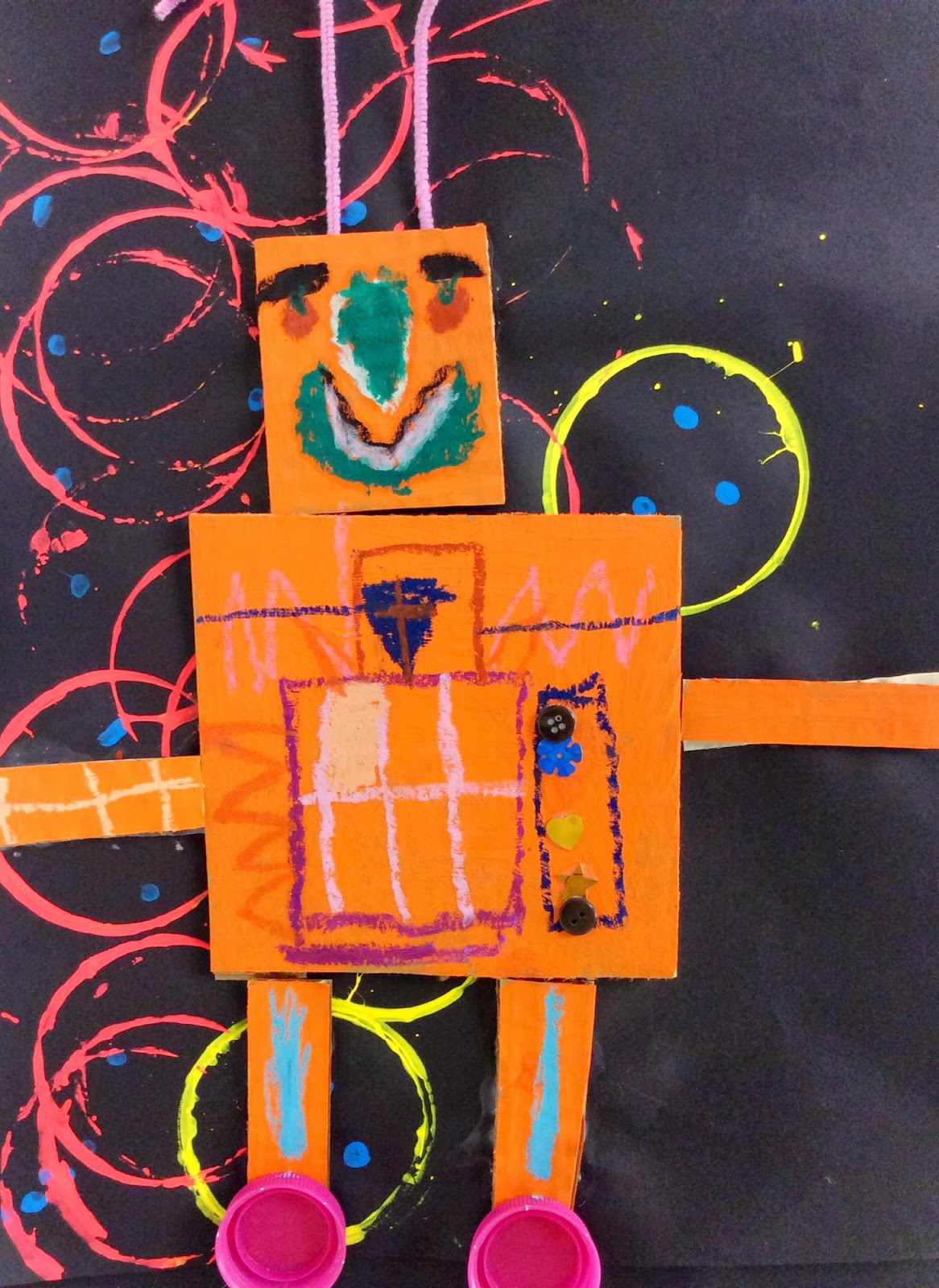
Color Robots - Kindergarten Collage of Shapes

 Kindergarten students created these fun collage robots while learning about shape and reviewing color. 


We started our project by using stamping different sized circles and dots to create a fun background. Students learned that you can paint with more things than a paintbrush. Plastic cups, paper cups, and cotton swabs can be fun painting tools.


Then students identified the shapes they could use in their robots as they painted them with a solid color. 


The next class it was time to put our robots together! Students glued their shapes in place, added details and embellishments with oil pastels, pipe cleaners, sequins, and plastic caps. Oh What Fun!!


This Robot is jumping for joy!!


Monday, January 14, 2013

Kindergarten Bird Paintings Inspired by Audubon

~ Geometric Shapes, Organic Shapes, and Drawing from Observation ~

Bluejay by Mathias

Kindergarten students learned a little about the artwork of John James Audubon with this lesson. We looked at some of his bird paintings and talked about how he observed birds in nature to see what they really looked like. 

We discussed what drawing from observation meant. Since we couldn't go outside in the cold and get a bird to sit still for us, we did our observation from photographs. I picked out a handful of birds that students would have seen in our area - Northwest Illinois - and printed out pictures for students to look at. We had just done a lesson in shape. We discussed the two kinds of shapes - geometric and organic (free-form) shapes before the students started drawing the bird they picked to do. I continued to remind students to look at the bird and see what shapes they saw and draw what they saw. One student got to giggling at me because I kept repeating "as you draw look at the picture then back to your paper...then back to the picture. Look at the picture...look at the paper...look at the picture..." He repeated "picture - paper- picture-paper" while giggling. But they got the idea and all really looked at the shapes they saw!

After drawing with pencils, I had the students go over the lines with a black Sharpie marker. The next class students painting their birds. Again they picked up the bird photos so that they could look at the colors as they painted. The birds below were painted with tempera cakes.  See more of our Kindergarten birds in our Artsonia gallery.

Mallard Duck by Alandra

Cardinal by Hailey

Robin by Olivia

Sunday, May 6, 2012

An Oldie But Goodie - Kindergarten Symmetrical Drip Butterflies

I've done this project with Kindergarten students and a similar one with 1st graders ever since I can remember. But it's one of those oldies but goodies! I'm sure many of you have done something similar.

This is usually a close to end of year project. The students get excited when I tell them we are going to make a butterfly with paint, but we are not going to use brushes and our fingers will not touch the paint! We review the primary colors and I demonstrate how they will fold the paper - "short side to short side". We open the paper up and I squirt some of the primary colors in lines an drips on one side in the shape of a V.

I refold the paper and show the students how to gently rub in circles on the folded paper. They will feel the paint be squished around. I used to use say "wax on - wax off" with the students...but only the occasional aide in the classroom knows what I mean these days!

After rubbing the paper the student is excited when I tell them to open it up and see what you got. The Oooo's and Ahh's that always follow bring smiles.


While I do this with a couple of students at a time at a table, the students work on making a butterfly body on black paper using construction paper crayons.
Here's my example - 


The next class we will cut out the dried paint wings and glue the body onto it.


I do a similar project with my 1st graders. We do the same process only with one color + black on bottom and white on the top to help teach value tints and shades.  Instead of a butterfly they make a longer body to create a dragonfly.

Friday, March 16, 2012

Head of Man? No...How about Head of Cat or Head of Dog!

Kindergarten Students Explore the Art of Paul Klee
My Kindergarten students had looked at one of Paul Klee's works earlier in the year when they were doing their fish printing. This time we revisited Klee's work to talk about the difference between Realistic and Abstract art work. Students discussed how the shapes and colors used in Head of Man (above) created an abstract portrait.

After our discussion I gave students the challenge of instead of drawing a "head of man" how about they do either a "head of cat" or "head of dog". They were excited by the project. We spent a few minutes discussing what shapes could be used to create these drawings. I drew some examples as they gave shape ideas.  Then they were off drawing their own. I asked them to draw out their picture using a black crayon first and then encouraged them to apply a lot of color using the crayons. I challenged them to mix color on top of color to create interest.

Here are some in progress shots of students drawing. 
I love the creativity the students were showing!


 Here's my example -
The next art class the students used watercolors to paint over their drawings. I had most of my classes just choose one color to paint over their cat or dog. We discussed the crayon-resist technique while doing this. I asked these young students what they thought crayons were made out of. Most of the answers were way off but I did have students in two of my six Kindergarten classes tell me "wax". We talked about how the wax would "resist" or not let the water stick to it.  A quick Art+Science connection made!  


Tuesday, March 13, 2012

Patterns are Dragon On!

Kindergarten and First Grade Pattern Review

This is a quick project that I do every few years. After working with Kindergarten and First grade students on patterns, it's a fun review and practice.
Draw out a very large dragon on bulletin paper.
Cut up paper plates into 4 sections. Give each student a section and have them use markers or crayons to create a pattern on the paper plate section. These will become the scales of the dragon. As students finish hot glue (fastest and easiest way) the sections overlapping.

I do this with both my Kindergarten and First grade classes so that there are enough "scales" to fill the dragon.


Now most years when I do this I plan for it to fall in February. This year was no different. I do this for two reasons. The first is then I could tie in with Chinese New Year celebrations. The second I have a cutesy saying that I like to put with the dragon - "Winter's DRAGON ON - Hurry Up Spring!"
However, our unusually mild Mid-West winter this year forced me to not put up that saying - it simply didn't apply this year!

Monday, February 20, 2012

It's Kindergarten Mona Lisa Time!

 Mona Lisa...Mona Lisa...we adore you...
Now I know some of you out there feel that this painting is overrated and perhaps it is. But we cannot deny that it is one of the most famous and recognized images in all the world. Because of that, I feel it necessary to expose my students to her early. In fact - she plays a major role in my art classrooms. I use her as a quiet signal to let students know I need their attention. I say "MONA!" and they respond "LISA!" and stop, look, and listen for directions.

This year - thank you Pinterest - I found a sign used by Scott Russell that uses the Mona Lisa as a guide to how they show they are ready to begin class or to be a good listener - and it works! You can see Mr. Russell's sign here and my adaptation below.


In one of my Art rooms I even have a section of a wall dedicated to Mona Lisa parodies. I'm always on the lookout for new ones!

But - on to the project! At the beginning of the school year, I introduce Mona to my Kindergarten students and any new to me students. I simply tell them that it is a very famous painting and that we will talk about it later in the school year.  Usually the beginning of third quarter I concentrate on teaching portraits to many of my grade levels. As part of the portrait unit for my Kindergarten, we use the Mona Lisa to learn about proper placement of features on the face and begin to learn how to draw the basic shapes.


I'm always so impressed with how these simple drawings turn out. Many of my older students look at them and think the Kindergarten students can draw better than they can!

These drawings always bring a smile to my face - a simple quiet smile just like Mona Lisa.


Here are some of my favorites from this year - 


Tuesday, January 17, 2012

Pattern with Kindergarten

There are so many ways to teach pattern to our youngest students. This one is a simple (usually one class period) lesson. I usually don't do this lesson until December or January. By this time of the year the Kindergarten teacher has already introduced the concept of pattern to the students. We discuss what patterns are and give some examples of AB patterns using color and shapes and then go on to discuss ABC patterns. Depending on the level of the students, we may go further discussing different patterns - I let the students guide this.

After our pattern discussion, students practiced making a three color pattern. If I do this lesson before Christmas I use a tree design and the students "decorate" the tree with primary colored pieces of paper. Students are given a green paper with a tree shape copied on it. They also get a strip of each primary color. I show them how to cut the strips into squares all at once to make the cutting go faster. I encourage students to place the strips into a pattern before they glue them down.

This is a great project to practice cutting and gluing skills along with reinforcing pattern.
 If time allows I let the students glue on some sequins to their tree. Of course they love that!


I've also done this project after the holidays. Instead of the tree design, a heart on red paper is used. The pattern is put along the inside of the heart.

Tuesday, December 6, 2011

Fish Printing (Gyotaku) with Kindergarten

A Lesson in Warm and Cool Colors


Last month I decided things needed to get a little fishy in the Art room! I had done Gyotaku (Japanese fish printing) with older students in years past and thought that my Kindergarten students would love this art form also.
I had two main things that I wanted to accomplish in this Fishy Unit. The first was to teach the students about warm and cool colors. The second was to introduce them to the artwork of Paul Klee. Klee is a target artist for Kindergarten students in my school district. My student teacher and I worked together to develop this fish unit.

The first day of our project, we discussed some things they thought of as warm or hot and things that were cool or cold. Students named things like fire, the sun, lava, and a stove for the warm/hot things and things like snow, water, rain, wind, and grass for the cool/cold things. We then looked at the color wheel and picked out the colors that were warm and cool.

After this warm/cool discussion we pulled out the watercolor paints and a 12x18 piece of newsprint. We told student that we were going to use the cool colors today in an underwater painting and then next art time they would begin printing a fish using the warm colors. We went through each cool color together and decided what kinds of things we could use those colors for in our painting. The blue made great water waves, the green created a variety of seaweed, and the violet was used to paint sea creatures.

The next class began the printing! I have six(yes 6!) Kindergarten classes this year between the three schools I teach at. They are not small classes either - so I knew that printing would take more than one class period. I felt it was better to have the majority of the students working on another artwork while we pulled 3-4 students at a time to a back table to do the fish printing.  The printing table was covered with newspaper and had 3-4 rubber fish, sponge rollers, warm color paint poured onto paper plates, and a small amount of black paint on a plate with a couple q-tips.  Each student picked a warm color to roll onto the fish then dotted the eye with a bit of black using the q-tip. Their painted paper was then placed, painted side down, onto the fish and they rubbed the fish for a minute or so. We reminded them to make sure they felt all the parts of the fish to transfer the paint. When they pulled the paper off and saw the fish a big smile covered their face!

The first printing day students worked on a color sheet that my student teacher created. One side had three fish that were to be colored with cool colors and the other side three fish to be colored with warm colors.
Most classes were able to get over half the students printed the first printing day - except for my 2 classes of 29 students each.
The next class we introduced Paul Klee to the students. 
His The Golden Fish Painting was shown to the students. 
We had a discussion about what they thought was going on in the picture and also examined the lines and colors. Warm and cool colors were again discussed. Students then spent the rest of the art time working on an oil pastel fish picture on black construction paper inspired by Klee's painting. While students did this project the rest of the students were able to print their fish.

Take a look at some of the finished fish prints!


Monday, August 29, 2011

Harold and the Purple Crayon - A Kindergarten Lesson in Line

An Introduction to the Art Element of Line

This is one of my first lessons of the school year with my Kindergarten students. I always target the Element of Line first with all students so this fits very well into that. We begin with a discussion of what lines are and how to we can make a variety of them. Then I read Harold and the Purple Crayon by Crockett Johnson.  We go back over the book after reading letting the students pick out the different kinds of lines Harold made. Then students are given a paper that has Harold on it and they use a purple crayon to draw some of the lines that Harold drew.
Large paper for group drawing - about 5 feet long
As students work on this individual paper. I lay out a large piece of white bulletin paper onto the floor. I have students, one group at a time come over and draw on the big paper with extra large purple crayons (ones like Crayola So Big crayons).
This paper is displayed with a big version of a cut out of Harold holding a purple crayon.

This book is a fairly small book and sometimes hard to share with a large group of students. This year I created a PowerPoint to show to the students on the Smartboard or projected on a screen.

You can find this PowerPoint here on my Art with Mrs. G website. That website is currently under construction as I set it up for my different schools and move some data onto it from a MobileMe website. But the Harold ppt is there for anyone to use.